Emergence
As the first image shown from the God Quest series, Emergence feels like an opening statement — not an explanation of the journey to come, but an announcement that something has begun to rise into view. The image has the quality of a vision half-formed and fully felt, as though it has surfaced from a deeper psychic or spiritual terrain before language has had the chance to organize it. It carries the charge of a beginning: mysterious, unstable, and alive.
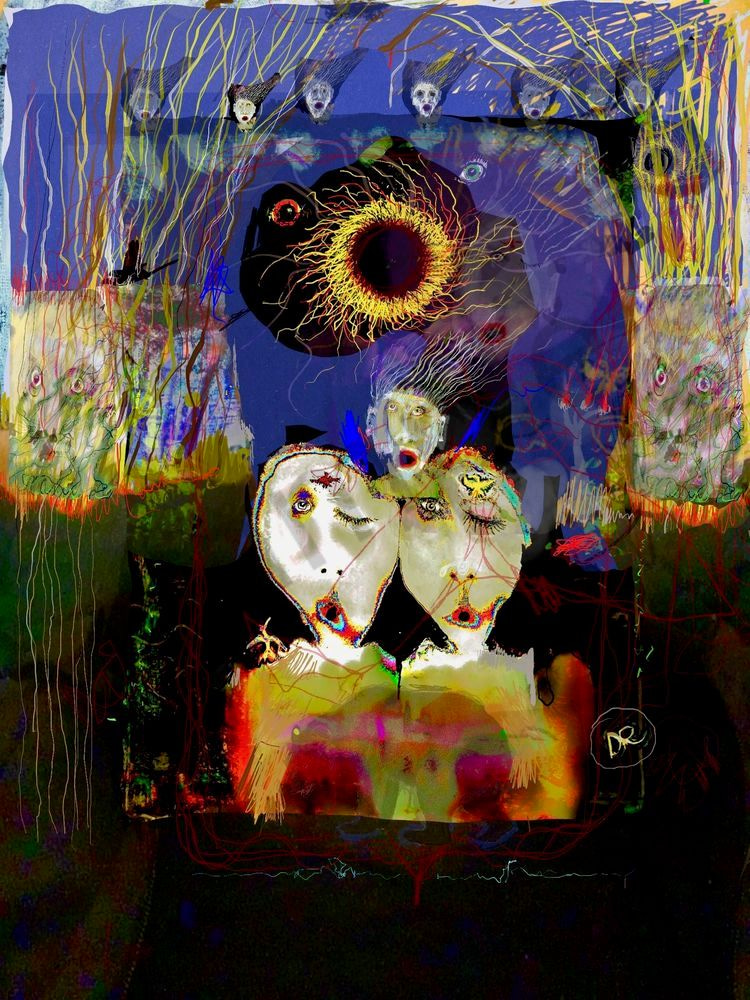
The composition is structured almost like a stage or altar. A dark circular form hovers near the top center, ringed with a blazing gold halo that suggests an eclipse, an eye, a sun, or a portal. It dominates the upper portion of the image, radiating both presence and uncertainty. This form feels cosmic, but not distant. It presses downward into the image, as if watching over or activating what is unfolding below. Around it, the blue and violet field gives a nocturnal or dreamlike atmosphere, reinforcing the sense that this is taking place in an inner realm rather than a literal one.
Beneath this celestial form sit two pale, childlike figures joined closely together. Their faces are simple, vulnerable, and mask-like, with a fragile emotional presence that feels innocent yet exposed. They could be companions, twins, witnesses, or two aspects of a single being. Their closeness gives the image a tenderness, but also a tension, as if they are huddled at the threshold of revelation. They appear not fully separate from their surroundings, but emerging through them — called forth by the energy above and the heated ground below.
The lower part of the image glows with reds, oranges, and yellows, like fire, molten earth, or an interior furnace. This base gives the work a feeling of transformation through heat — a place where something is being forged, birthed, or tested. Between the luminous ground and the darkened upper field, the central figures seem suspended in a zone of becoming. They are not settled. They are arriving.
The surrounding marks and textures add to this sense of unstable formation. Vertical streaks, blurred edges, and flickering lines suggest growth, static, weather, or spiritual interference. The world of the image is porous. Boundaries between landscape, body, and atmosphere are not fixed. Everything appears to be in a state of transition, which makes the title Emergance especially fitting. Whether intentionally altered or intuitively misspelled, the word gains force through its roughness. It feels less like a polished concept and more like a direct naming of the act itself: emergence as event, not theory.
Within the context of God Quest, this work feels foundational. It introduces the sense that the series is not about certainty or doctrine, but about seeking through image — allowing forms to arise from darkness, memory, sensation, and the unconscious. Emergance does not offer a resolved spiritual symbol. Instead, it shows the first stirring of one. It is the beginning of a search, the moment when something hidden pushes forward and takes shape, however strangely, before the viewer’s eyes.