Mother’s Love
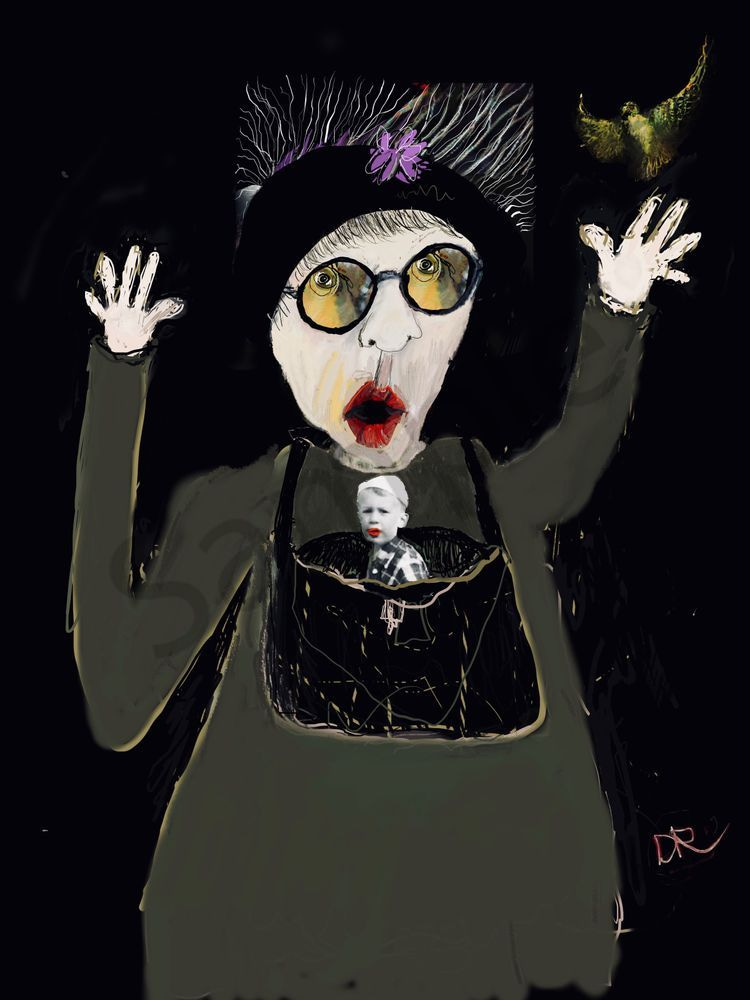
Mother’s Love presents a figure that is at once protective, theatrical, vulnerable, and strange. Against a deep black field, a solitary woman-like presence rises into view with both hands lifted, as if startled, blessing, calling out, or holding an invisible boundary around herself. The gesture is open and frontal, immediate in its emotional force. It gives the work a charged stillness, as though the figure has just been interrupted in a private act of care or revelation.
The face is pale and mask-like, simplified almost to the point of emblem. Large circular eyes dominate the head, reading as spectacles, shields, or radiant discs of perception. They give the figure an exaggerated alertness, a sense of watchfulness that feels central to the title. This is not a sentimental image of motherhood. It is an image of a mother as witness, guardian, and vessel—someone exposed to the world yet also standing between worlds. The open red mouth intensifies that feeling. It may be speaking, gasping, singing, warning, or calling. Whatever the emotion, it is direct and unsoftened.
At the center of the torso, an interior image appears: a smaller face or enclosed presence held within the dark chest area. This embedded form is crucial to the work. It suggests that motherhood here is not only an outward relation but an inward carrying. The child, memory, or loved presence is literally held inside the body, protected yet inseparable from the self who bears it. This inner chamber turns the figure into a container of attachment, making the title feel layered and complex. Love is not shown simply as tenderness; it is shown as burden, bond, incorporation, and exposure.
A thin descending line and small circular forms below the chest reinforce the vertical structure of the image, as though the body is organized around a symbolic axis. These details feel like medallions, talismans, or markers of passage. They give the figure a ceremonial quality, suggesting that the emotional bond at the center of the work has the gravity of ritual. Motherhood becomes not merely a role but a condition of being marked, changed, and permanently connected.
The small winged presence near the upper right adds another note of meaning. It may be read as moth, bird, messenger, or spirit. Its delicate scale contrasts with the bold central figure, yet it expands the emotional field of the piece. It suggests visitation, fragility, or the quiet nearness of something fleeting. In relation to the title, it may evoke the unseen dimensions of care: anxiety, memory, protection, or the soul-like presence that hovers at the edge of maternal attention.
There is also a striking tension between humor and unease in the image. The figure’s large round eyes and simplified features carry a cartoon-like directness, yet the overall atmosphere is not playful in any easy sense. The work feels psychologically charged. The raised hands can be read as both embrace and defense. The face feels both expressive and masked. The inner figure reads as both beloved and haunting. These contradictions give the image its depth. Mother’s Love becomes a portrait not of idealized motherhood, but of its intensity—its vigilance, its strangeness, its instinct to hold and protect even when the self feels fragile or overwhelmed.
What makes the work compelling is the way it transforms a familiar theme into something more mythic and ambiguous. The mother here is less a literal person than an archetypal presence: watchful, exposed, and carrying another life inside her own. Love is shown not as calm reassurance, but as an active, almost visionary state—one that includes fear, devotion, protection, and the mystery of being bound to another being at the deepest level.