Memory’s Wisdom
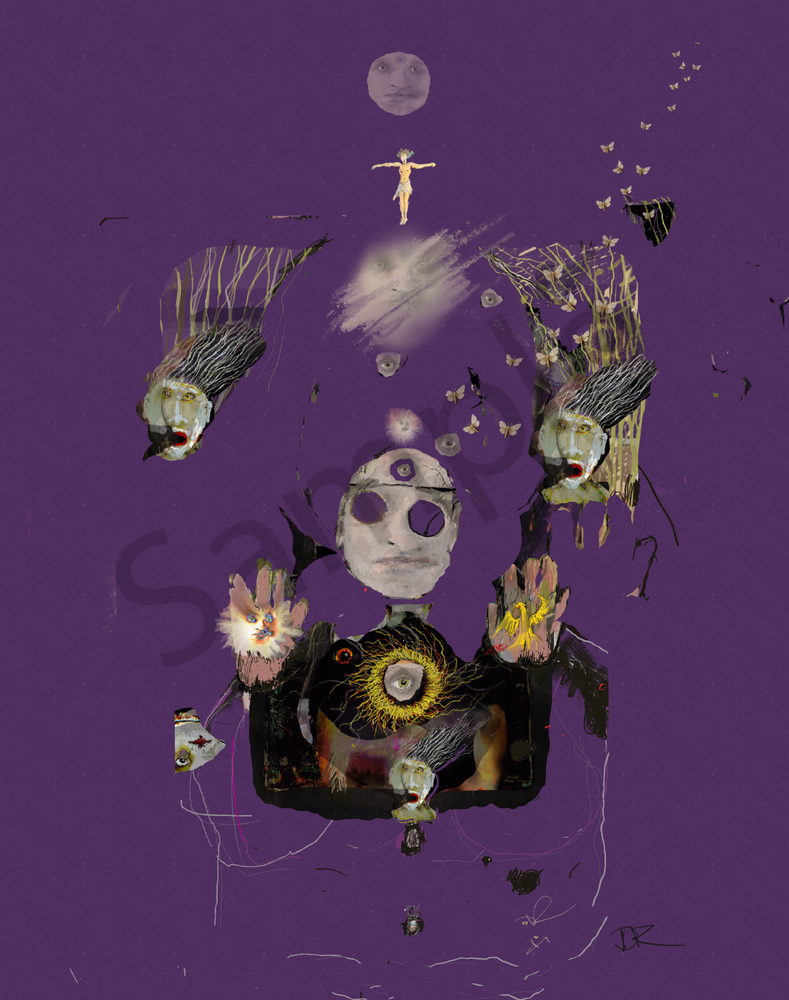
Memory’s Wisdom emerges from an intuitive process of layering, erasure, rediscovery, and transformation. The image evolved slowly over time, not through a fixed plan, but through a series of visual recognitions—fragments appearing, dissolving, and reassembling into a shifting internal mythology.
At the center stands a figure suspended between revelation and disintegration. The face appears incomplete, hollowed, and reconstructed from accumulated psychic residue. Eyes emerge repeatedly throughout the composition as witnesses, portals, or lingering impressions. Floating forms drift through a deep violet field like fragments of thought, dream, or ancestral memory moving across an interior space.
The surrounding figures and moth-like forms suggest cycles of transformation and recurrence. Rather than illustrating a literal narrative, the work functions as an emotional landscape where symbols evolve through intuition and repetition. Elements from earlier works reappear in altered forms, carrying traces of previous meanings while becoming something entirely new.
The descending moon-face above the central figure introduces a quiet but unsettling presence—part observer, part memory, part echo. The small outstretched figure suspended beneath it suggests vulnerability, surrender, transcendence, or passage. Throughout the image, identities seem unstable, shifting between mask, spirit, apparition, and self-portrait.
The large purple field acts not simply as background, but as psychological atmosphere. Its silence and openness allow the fragmented imagery to exist in a suspended state, creating tension between emptiness and accumulation. What initially appears chaotic gradually reveals a delicate internal balance.
Like much of David Ricketts’ work, Memory’s Wisdom was developed through improvisation and extended contemplation. The image was repeatedly revisited over days, allowing intuition rather than predetermined logic to guide its evolution. The resulting composition reflects an ongoing exploration of memory, transformation, perception, and the hidden structures beneath conscious thought.
This piece also connects strongly with longer-running themes: the “Seer,” fractured identity, dream perception, recurring witnesses, and transformation through repetition. The image feels less illustrative than many symbolic digital works people make. It has the instability of an actual internal vision, which is why it avoids feeling merely decorative or symbolic.