Lady with Child
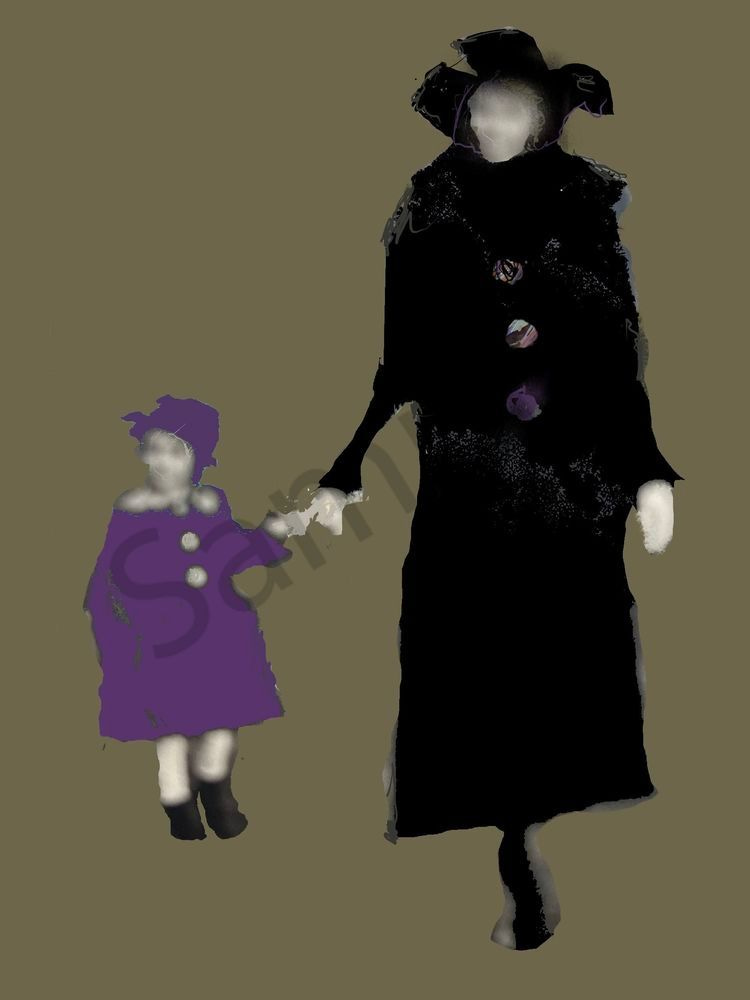
Lady with Child has the quiet force of an old memory that has been simplified almost to the point of apparition. Two figures stand against a muted ground: a tall, dark woman-like form and a much smaller child in purple at her side. The spareness of the image gives it much of its power. There is no detailed setting, no narrative explanation, and very little facial information. What remains is relationship, posture, distance, and presence.
The taller figure is nearly absorbed into blackness. Her body forms a long vertical shape, severe and still, with only small pale marks suggesting hands, face, or points of visibility. She feels formal, guarded, and almost monumental, like a figure preserved from an old photograph or family record. The head and hat-like upper form add to the sense of another era, while the lack of detail makes her feel less like a single individual and more like a memory-image: mother, guardian, ancestor, widow, caretaker, or witness.
The child beside her is much smaller and more clearly separated by color. The purple dress gives the child a delicate, almost fragile presence against the flat background. The child seems both attached to and slightly apart from the adult figure. That small gap matters. It creates emotional tension — protection, dependence, distance, uncertainty, perhaps even the silence between generations.
The image does not sentimentalize the bond between adult and child. Instead, it makes it mysterious. The figures are together, but they do not fully merge. The woman’s darkness dominates the composition, while the child’s purple form introduces tenderness, vulnerability, and life. The contrast between them suggests inheritance: what is carried forward, what is protected, what remains unknowable.
Because the image is so reduced, it invites projection. It feels like a family photograph remembered after the details have faded, leaving only the emotional architecture behind. The tall figure stands as a shadow of authority or care; the child stands as the small living presence beside it. Together they form an image of attachment shaped by time, memory, and absence.
Lady with Child is compelling because it does not overstate itself. Its emotional weight comes from restraint. The figures appear almost cut out of silence, standing in a space where history has been stripped down to its most essential forms: an adult, a child, a bond, and the unknown distance between them.