Head in the Clouds
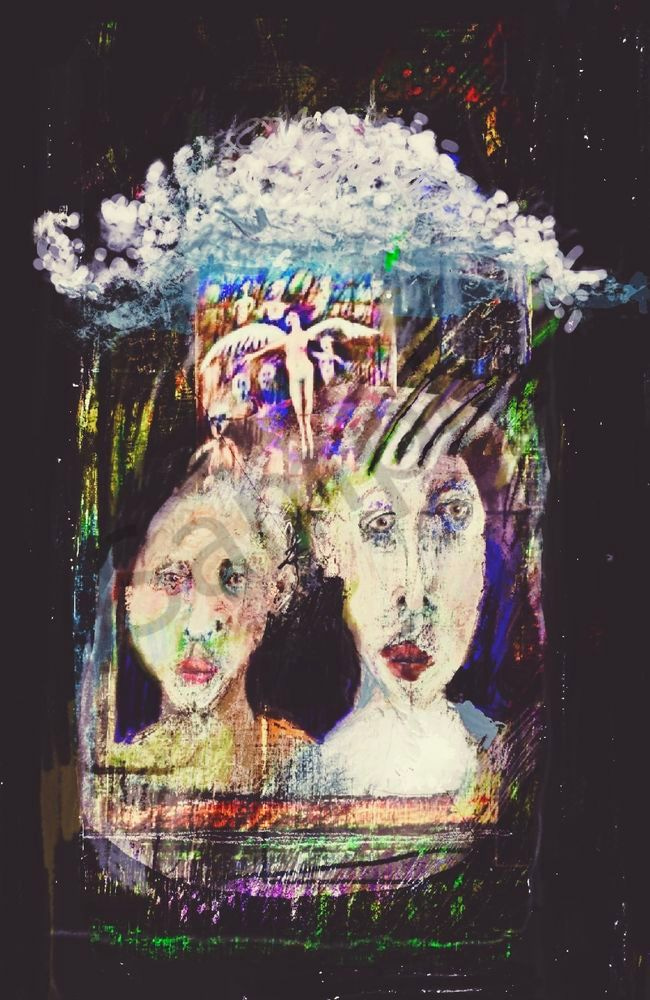
Head in the Clouds presents two pale figures enclosed within a dark, luminous chamber of layered marks, color, and memory. Above them, a cloud-like form gathers at the top of the image, hovering between thought, weather, spirit, and eruption. The title suggests dreaminess or distraction, but the image complicates that phrase. This is not simply a figure lost in fantasy. It feels more like consciousness rising, breaking apart, or being overtaken by something larger than the self.
The two faces at the center carry different emotional weights. The figure on the right appears more alert, open-eyed, and exposed, with dark marks rising from the head like hair, antennae, or psychic extensions. The figure on the left feels softer and more ghostlike, almost as if it is fading into the surface or emerging from an older layer of memory. Together they suggest doubled identity: companion and witness, child and adult, inner self and outer self, or two states of awareness occupying the same fragile space.
Above them, the smaller image of a white, outstretched figure introduces a strong note of transcendence. It could be read as a dancer, angel, apparition, or signal of release. Suspended within a field of charged color, this small figure becomes the emotional hinge of the composition. It seems to rise from the heads below, as though thought itself has taken bodily form and entered another realm.
The cloud form at the top is especially important. It has the softness of vapor, but also the density of accumulated experience. It feels like a burden, a vision, a dream mass, or a gathering of unseen forces. Rather than floating lightly, it presses down and rises at the same time, creating tension between heaviness and release. The image suggests that imagination is not escape; it is a place where unresolved feelings, memories, and symbols gather.
The dark surrounding field gives the work an icon-like quality. The figures appear framed or contained, as if preserved inside a shrine, window, or private theater. Scratches, stains, and color fragments along the edges preserve the sense of process, making the image feel aged, handled, and repeatedly returned to. The work does not hide its making. It allows revision, residue, and accident to remain part of its emotional surface.
Like much of David Ricketts’ work, Head in the Clouds moves between portrait, dream image, and psychological relic. It resists a single explanation and instead invites slow looking. The longer one stays with it, the more the image shifts: from tenderness to unease, from innocence to revelation, from a simple phrase into a layered meditation on imagination, memory, and the divided self.
At its core, Head in the Clouds is about the unstable space between inner vision and outer presence. It captures the feeling of being partly here and partly elsewhere — grounded in the body, but drawn upward into the weather of thought, dream, and spirit.