"
Divine Exploration
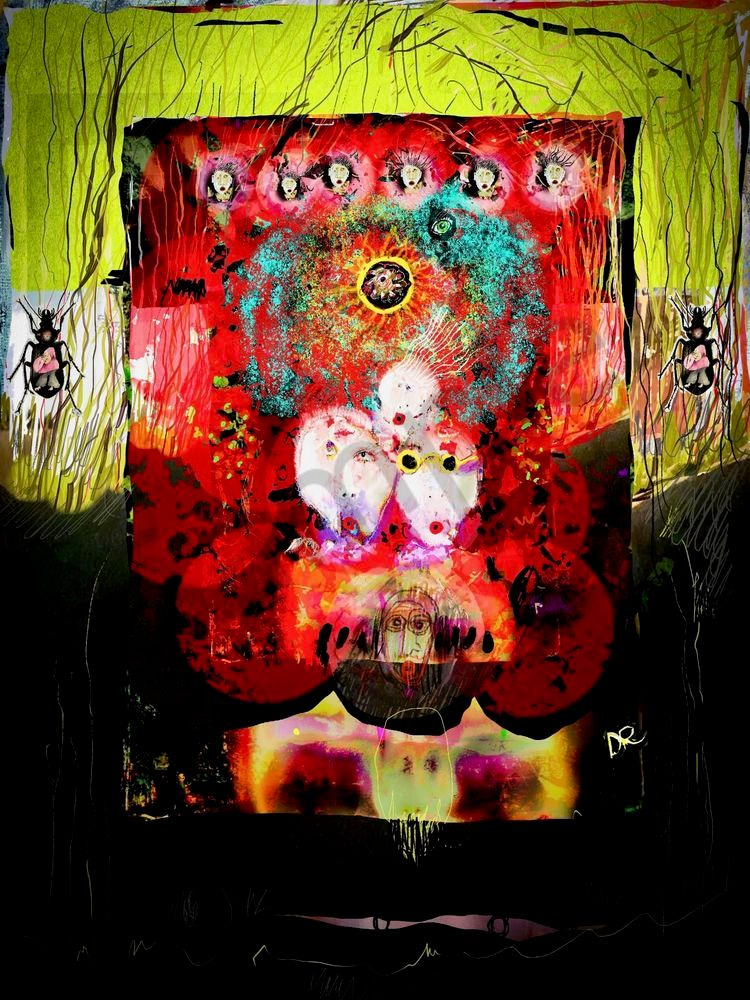
Divine Exploration presents a dense, charged vision of spiritual searching. The image feels like a shrine, a stage, or an interior chamber where symbols gather around two small pale figures at the center. These figures appear vulnerable and watchful, almost childlike, yet they stand within a field of immense psychic pressure. They are not simply observing the mystery around them; they seem to be inside it, surrounded by forces larger than themselves.
The dominant red field gives the work its heat and intensity. It suggests blood, fire, revelation, danger, and sacred energy all at once. This red space is not empty. It is filled with circular forms, eye-like presences, and hovering marks that create the sense of a living spiritual atmosphere. The figures are enclosed by this field as though they have entered a zone where ordinary perception no longer applies.
Near the upper center, a large circular form radiates with an eye-like force. It becomes the visual and symbolic center of the image: a sun, portal, deity, wound, or point of vision. Around it, smaller shapes appear like witnesses, spirits, or fragments of consciousness. The divine here is not calm or polished. It is active, unstable, and overwhelming. It feels discovered through intensity rather than comfort.
The two figures below carry much of the emotional weight. Their pale faces and simple bodies contrast sharply with the red field around them. They feel exposed, almost fragile, yet they remain present. Their closeness suggests companionship, duality, or two aspects of the same seeker. Within the larger context of God Quest, they read as travelers or initiates standing before forces they cannot fully understand.
The lower part of the image darkens dramatically, grounding the composition in black and deep shadow. This darkness makes the red chamber above feel even more luminous and dangerous. The glowing base beneath the figures suggests an altar, furnace, threshold, or place of transformation. The image feels as though something is being tested or revealed there.
The title Divine Exploration is fitting because the work does not present divinity as a fixed answer. Instead, it shows the search itself: uncertain, strange, vivid, and emotionally charged. The figures are not receiving a simple blessing. They are entering a field of signs, eyes, heat, and mystery. The divine appears as something encountered through risk, imagination, vulnerability, and the willingness to stand inside the unknown.
What makes the image compelling is its mixture of innocence and intensity. The small figures seem almost tender, while the surrounding space is fierce and crowded with symbolic energy. That contrast gives the work its power. Divine Exploration becomes an image of spiritual inquiry not as doctrine, but as experience — a movement into vision, uncertainty, fear, wonder, and transformation.