You Were Expecting Flowers
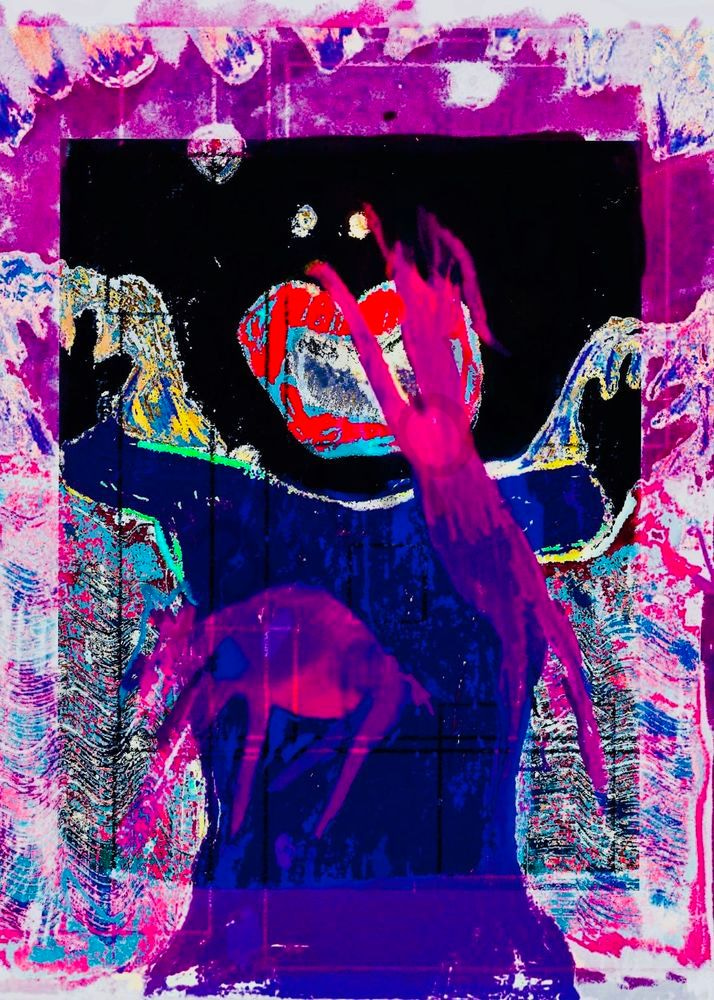
You Were Expecting Flowers is a sharp, confrontational title, and it changes the emotional temperature of the image in a useful way. The work presents a dark central figure or form emerging from a vivid field of magenta, violet, blue, and black. At first glance, the image has the energy of a floral or decorative burst, but that expectation is quickly disrupted. What appears instead is stranger, more bodily, and more psychologically charged.
The dark rectangular center creates the feeling of a doorway, stage, void, or interior chamber. Within it, a figure-like presence pushes forward, partly obscured by saturated color and restless movement. The central red and pale form near the upper body reads almost like an open mouth, wound, mask, or cry. It becomes the image’s emotional pressure point — a place where something raw breaks through the surrounding darkness.
The surrounding colors are lush but uneasy. The magenta and blue tones might suggest petals, blossoms, or ornamental beauty, but they also feel electric, bruised, and unstable. This tension is exactly where the title works. “You Were Expecting Flowers” suggests a reversal: the viewer came looking for beauty, softness, or reassurance, but the image offers something more difficult. Instead of flowers, there is eruption. Instead of decoration, there is confrontation.
The pale curved forms on either side of the central figure create a sense of wings, arms, horns, or broken symmetry. They extend outward but do not resolve into comfort. They make the figure feel animated, even theatrical, as if caught mid-gesture. The lower red and purple forms add to the bodily quality of the image, suggesting movement, struggle, or transformation taking place in shadow.
What gives the work its strength is its refusal to be pretty in a conventional way, even though it uses colors that could easily become decorative. The image takes beauty and unsettles it. It turns the expectation of flowers into something stranger: a figure surfacing from an inner chamber, carrying intensity rather than charm.
You Were Expecting Flowers becomes a statement about expectation itself. It challenges the viewer’s desire for easy beauty and replaces it with something more honest, volatile, and alive. The work feels like a bloom, but not a gentle one — more like a psychic flowering, a rupture, or a dark theatrical emergence from beneath the surface.