This image presents two mirrored, face-like forms held within a field of sweeping movement and charged color. The composition feels intimate and unstable, as if two presences have appeared inside the same dream-space but remain separated by a pale dividing shape that curves between them. The figures seem close enough to touch, yet enclosed within their own oval worlds.
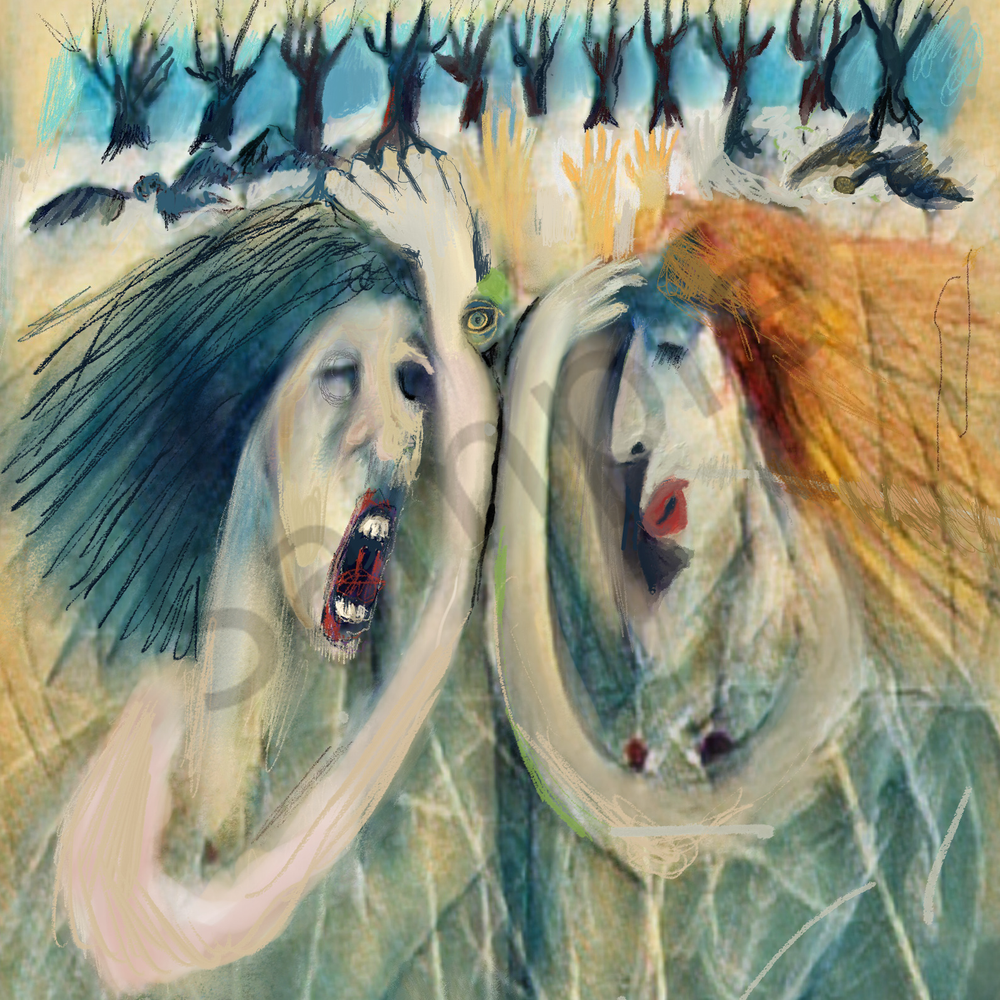
This image presents two mirrored, face-like forms held within a field of sweeping movement and charged color. The composition feels intimate and unstable, as if two presences have appeared inside the same dream-space but remain separated by a pale dividing shape that curves between them. The figures seem close enough to touch, yet enclosed within their own oval worlds.
Each face carries a different emotional temperature. The left side is darker, cooler, and more shadowed, with blue-green marks suggesting water, night, or inwardness. The right side is warmer, touched by yellow and ochre, with marks that feel like wind, light, or dry grass. Together they create a strong duality: night and day, interior and exterior, memory and awakening, two selves looking out from different states of being.
The pale central form is especially important. It rises between the faces like a branch, veil, flame, or boundary. It does not simply divide the image; it also connects it. The two faces seem formed around it, as if this central shape is the force that both separates and holds them together. It may suggest a shared body, a split identity, a passage between two states, or the fragile membrane between one consciousness and another.
The mouths of the figures are small but intense, darkened like openings, wounds, or cries. They introduce a feeling of speech or attempted speech, as though each figure is trying to communicate from within its own enclosure. The eyes are quiet, almost hidden, but the mouths make the image feel emotionally active. Something is being felt, perhaps even sounded, but not fully released.
Across the top of the image, dark branching marks create a rough crown or horizon line. These forms feel like trees, antlers, nerves, or written signs. They give the piece an almost ritual atmosphere, as if the two figures are beneath a canopy of memory or symbolic growth. The surrounding strokes move diagonally and vertically, creating a sense of pressure and motion around the otherwise contained faces.
The work feels less like a conventional portrait than an image of division and relation. It suggests the way parts of the self can stand beside each other, separate but linked, each carrying its own weather. There is tenderness here, but also unease. The figures appear vulnerable, exposed, and partially dissolved into the field around them.
The strength of the image lies in its balance between simplicity and psychological depth. The forms are direct, almost childlike, yet the emotional atmosphere is complex. It feels like a private icon of dual presence — two beings, two selves, or two memories held in the same frame, divided by a pale threshold that may be wound, bridge, or awakening.