Conversation After Yesterday’s Nap
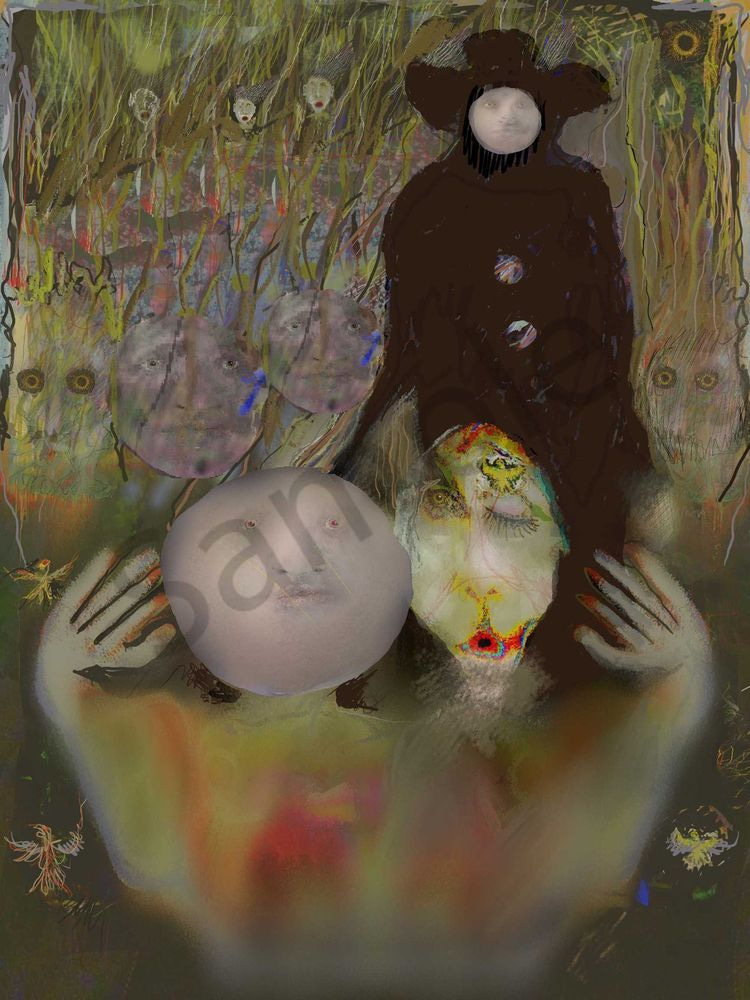
Conversation After Yesterday’s Nap unfolds like a dream remembered only in fragments—part scene, part visitation, part emotional residue. The image is organized vertically, with one dark standing figure rising in the upper field and a larger, softer presence occupying the foreground below. Between them, the space feels suspended, as if something has just been exchanged or revealed but cannot be fully translated into ordinary language.
The upper figure is stark and simplified: dark-bodied, upright, and almost iconic, with a pale circular face that reads like a mask, moon, or blank point of awareness. It stands with a quiet authority, neither fully human nor entirely symbolic. Because it hovers above the rest of the image, it feels like a witness, a visitor, or an interior presence that has stepped forward after sleep. There is a stillness to this figure that contrasts with the softer and more fluid forms below, giving it the role of something remembered clearly even when the rest of the dream remains unstable.
In the foreground, a larger pale form rises with both hands open at either side, as if in offering, questioning, or quiet astonishment. This lower figure feels less fixed than the one above. It appears translucent, almost melting into the surrounding field, with its body serving as a vessel for other presences. Two rounded, face-like forms rest within or before it, creating the impression of a layered self, a shared consciousness, or a gathering of inner voices. These smaller presences feel intimate and vulnerable, as if the conversation of the title is taking place not only between figures, but within the self.
The background is crucial to the atmosphere. Greens, browns, and muted golds create a mottled field that suggests vegetation, weathered walls, or a dream-space where nature and memory overlap. Nothing is sharply separated. The forms seem to emerge from the same living substance, reinforcing the feeling that this is less a literal event than a psychic one. The small winged marks near the bottom corners add another delicate note—like tiny messengers, fragments of thought, or hovering signs that the visible scene is surrounded by subtler energies.
The title Conversation After Yesterday’s Nap gives the work its emotional entry point. It suggests that the image grows out of that strange state after sleep when thoughts, dreams, and waking awareness mingle. A nap can open a brief chamber in which unexpected presences appear—memories, voices, unresolved feelings, or symbolic companions. The “conversation” here may not be spoken aloud. It may be an exchange between different aspects of the self, between waking and dreaming, or between the conscious mind and something older and less explainable.
What gives the image its power is its refusal to settle into one meaning. It feels tender, uncanny, and slightly comic at once, yet beneath that there is genuine psychological depth. The figures do not narrate a story so much as embody a state of encounter. Conversation After Yesterday’s Nap becomes an image of those in-between moments when the boundary between inner and outer life softens, and something quiet but unmistakable begins to speak.