Ritual
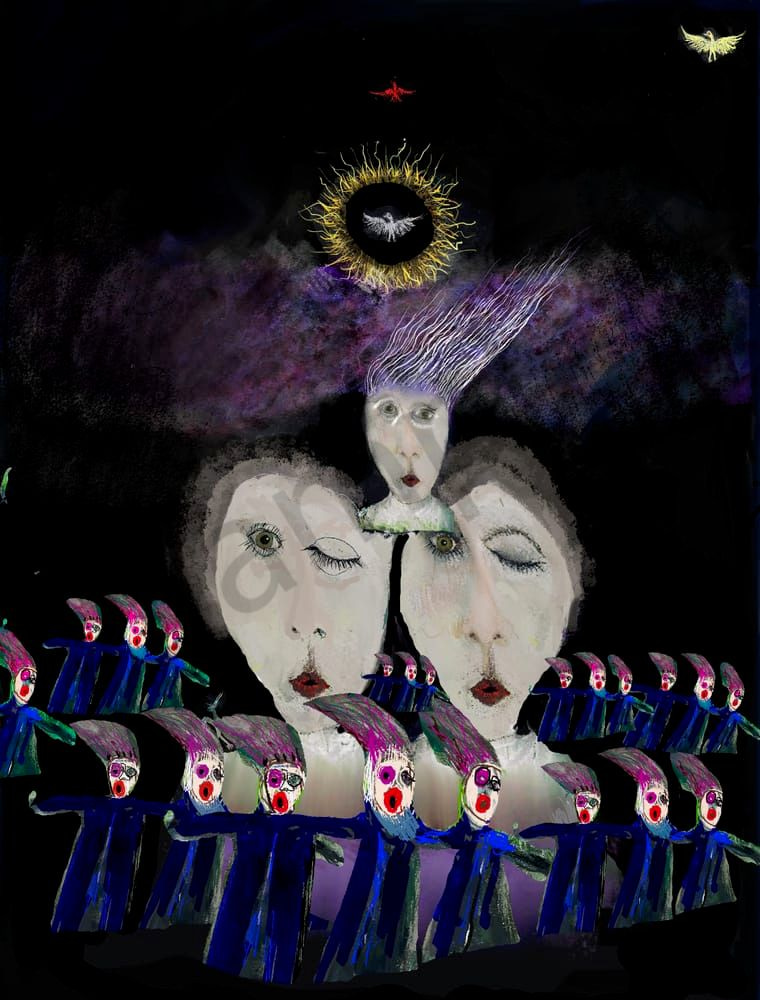
Ritual presents a ceremonial scene that feels both intimate and cosmic. Two pale, mask-like figures stand close together at the center of the image, their heads leaning inward as if joined by secrecy, kinship, or shared initiation. They appear vulnerable, almost childlike, yet they also carry the stillness of icons or ritual participants. Their simplified faces do not explain their emotional state; instead, they hold the viewer in a suspended atmosphere of witness and mystery.
Above them, a small animal-like or spirit-like presence rises from between their heads, as though something has been summoned through their union. Higher still, a dark circular form hovers in the sky, ringed with light like an eclipse, an eye, or a portal. This upper form gives the image a strong vertical pull, linking the figures below to a larger force above them. The composition suggests that the ritual is not merely human. It is connected to a wider field of unseen energy, memory, and spiritual searching.
The purple-black atmosphere behind the figures deepens the sense of night, dream, and inward ceremony. It feels like a space where ordinary reality has been dimmed so that symbolic presences can appear more clearly. The small white bird or moth in the upper right adds another delicate sign of visitation, escape, or messenger energy. It is minor in scale, but important in feeling: a small living mark against the vast dark field.
Across the lower part of the image, a horizontal band of repeated forms creates the feeling of a procession, altar, boundary, or gathered witnesses. These repeated shapes seem to pulse with red, blue, and white, giving the bottom of the work a rhythmic, almost musical structure. They ground the two central figures while also suggesting that the scene is part of a larger ceremony already underway.
The title Ritual fits because the image feels less like an event being described and more like an action being enacted. Something is being joined, called forth, marked, or transformed. The two central figures may be participants, offerings, guardians, or twin aspects of a single self. The hovering eye-like form above them suggests that the ritual is being watched, sanctioned, or activated by a presence beyond the visible world.
Within the broader language of the God Quest series, Ritual feels like a moment of formal passage. It does not offer certainty or doctrine. Instead, it presents a threshold where figures, symbols, and forces align. The work carries the emotional charge of an ancient ceremony remembered through dream: strange, tender, and slightly ominous. It invites the viewer to stand before it not as a puzzle to solve, but as an image of transformation taking place.