Ascending Angel
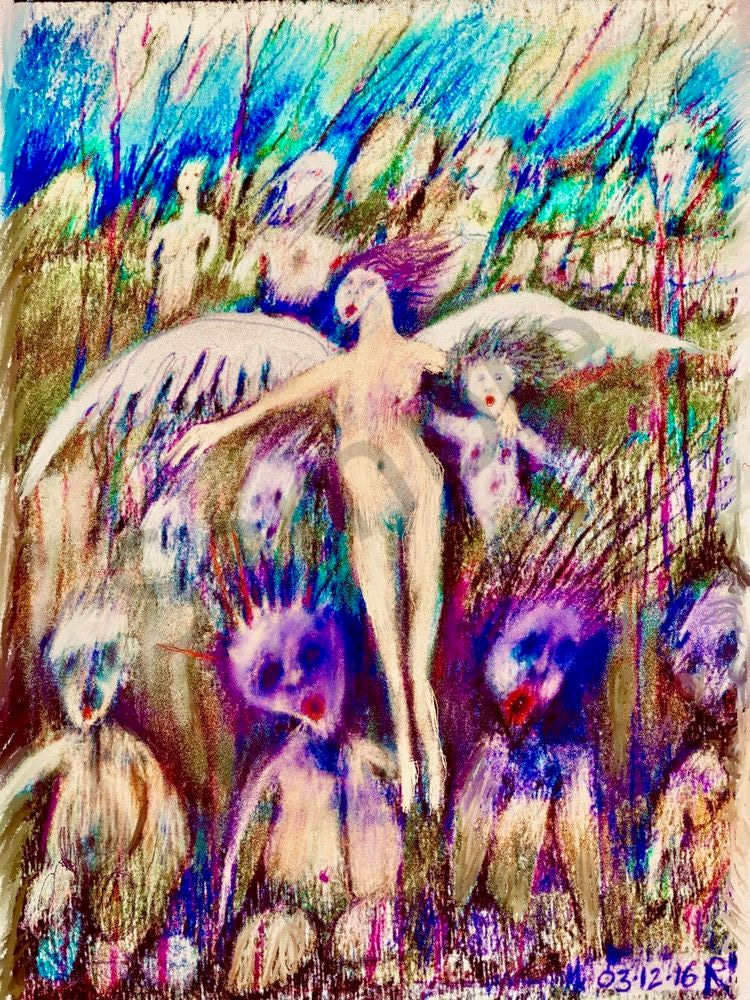
Ascending Angel feels like a vision caught in the middle of transformation. The image presents a loose, luminous field where figure, landscape, and spirit seem to merge. Nothing is fixed or fully separated. The central pale form rises through the composition like a body becoming apparition, or an apparition becoming body. It has the vertical pull of ascent, yet it still appears rooted in the active, earthly field below.
The angel here is not a polished religious figure. It is fragile, strange, and partially formed. Its pale body stretches upward with a quiet insistence, while a darker head or mask-like presence gives it an inward, watchful quality. The figure seems to be moving through a charged atmosphere rather than standing in front of one. It is both emerging from the surrounding marks and dissolving back into them.
Around the central figure, the image is alive with restless color and movement. Blues and greens sweep across the upper field like wind, water, vegetation, or sky. Warmer purples, reds, and yellows rise from below, suggesting inner heat, growth, or spiritual disturbance. The entire surface feels animated, as if the world itself is participating in the ascent.
To one side, another pale shape bends or leans close to the rising figure. This companion form adds emotional tension. It may be a witness, a guardian, a remnant of the body left behind, or another spirit caught in the same passage. The relationship between these forms keeps the image from becoming simply symbolic. It feels personal, as though the ascent carries attachment, memory, and uncertainty with it.
The smaller rounded forms near the lower and side areas resemble eyes, flowers, seeds, or minor spirits. They give the landscape a sense of consciousness. The ground is not passive; it watches, receives, and generates. This makes the angel’s ascent feel less like escape and more like a movement through a living field of forces.
The title Ascending Angel gives the image a devotional charge, but the work resists easy sentiment. This is not an angel of reassurance. It is an angel in process — vulnerable, raw, and still entangled with the material world. The ascent feels earned rather than graceful, uncertain rather than triumphant.
What makes the image compelling is its openness. It allows the angel to remain partly unresolved, as if the act of becoming is more important than arrival. The figure rises, but the viewer is left inside the mystery of what that rising means: release, transformation, awakening, death, birth, or vision. Ascending Angel becomes an image of passage — the moment when something hidden in the body, the earth, or the unconscious begins to lift into view.