The Choir
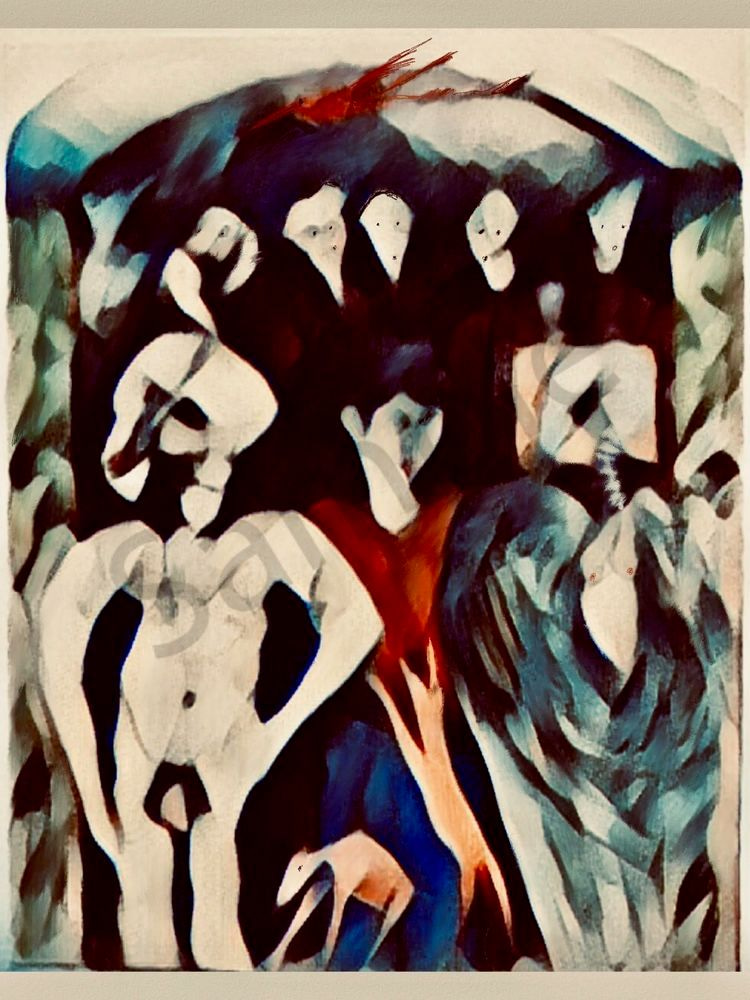
The Choir gathers a cluster of human-like presences into a single charged field, where figure, voice, and atmosphere seem to merge. The image does not present a choir in any literal sense. Instead, it evokes the idea of a chorus as a collective force — many beings sounding together, holding separate identities while participating in something larger, older, and more difficult to name.
Across the composition, pale forms emerge from a loose, fluid structure of deep reds, blacks, blues, and whites. Several of the heads appear as simplified, mask-like shapes, suspended or hovering within the upper portion of the image. They do not behave like ordinary portraits. They feel more like notes, spirits, or witnesses — individual presences gathered into a common field of resonance. This repetition of head-like forms creates the sense of multiple voices occupying the same space, as if the image itself were humming with layered sound.
At the center, a darker vertical force rises through the composition, touched by red and blue passages that give the work both heat and movement. This central structure suggests an axis around which the other forms gather. It may be read as a conductor-like presence, a shared source of energy, or simply the emotional spine of the piece. Around it, the figures feel as though they are leaning into a common utterance, not in rigid harmony but in a rough, living accord.
The figure on the left, pale and exposed, stands with an almost vulnerable simplicity, while the surrounding forms on the right seem more fluid and engulfed by movement. This contrast adds tension to the work. Some voices feel embodied and immediate; others seem to dissolve into atmosphere. The painting holds both conditions at once: presence and disappearance, individuality and merging, declaration and absorption.
The color structure is essential to the mood. Deep maroons and blacks create a sheltering but unsettled space, while flashes of white cut through the darkness like vocal bursts or spiritual signals. The blue passages bring a cooler countercurrent, softening some areas while intensifying the sense of emotional depth. Nothing in the image feels fixed. Edges blur, forms shift, and the whole composition seems to vibrate as if activated by unseen sound.
The title The Choir invites the viewer to experience the work as something more than a gathering of figures. A choir implies breath, collective timing, and the transformation of separate voices into one resonant body. In that sense, this image becomes less a scene than an event. It suggests a moment when many inner presences — memories, selves, spirits, ancestors, witnesses — begin to sound together. Not all are clear. Not all are resolved. But together they create a field of emotional and symbolic intensity.
What makes the work compelling is its refusal to settle into either narrative or pure abstraction. It remains suspended between those states, using the language of figures without becoming descriptive, and using painterly gesture without abandoning emotional presence. The Choir feels like a gathering at the threshold of speech or song: rough, haunted, communal, and alive. It suggests that beneath the solitary self there may always be a chorus — many voices rising at once, asking to be heard.